
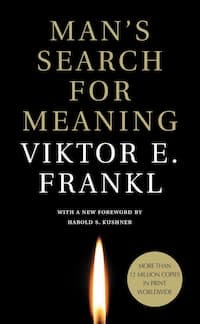
One of my all time favorite books is Viktor Frankl’s “Man’s Search for Meaning”. It’s one of those books I come back to every few years.
If you’re not familiar, Frankl was a Viennese psychiatrist who survived Auschwitz. But before the camps, he faced an impossible choice. In 1941, he held an American visa. Freedom. Safety. The chance to continue his work on meaning and psychology. At 36, he could escape Vienna before things got worse.
His parents couldn’t leave.
So Frankl wrestled with what to do. Then he noticed a piece of marble on a table at home. His father had salvaged it from their synagogue after the Nazis burned it down. One Hebrew letter was visible, part of the Ten Commandments.
“Which commandment?” Frankl asked.
“Honor thy father and thy mother.”
Of all the commandments that could have survived the fire, his father happens to salvage the one about respecting your parents? If I didn’t know better, I’d say that’s some world-class guilt delivery.
Frankl let the visa expire. He stayed with his parents.
He couldn’t have known his parents would die in the camps anyway. He couldn’t have known he’d survive to write one of the most important books of the twentieth century. He just made a choice and moved forward.
What I Keep Coming Back To
Every time I read Frankl’s story, two things hit me.
The first is gratitude.
I know that sounds obvious. Of course reading about Auschwitz makes you grateful you’re not in Auschwitz. But it’s more than that. Frankl describes standing in the freezing cold, starving, watching fellow prisoners work themselves to death. He describes the daily humiliations. The random violence. The complete uncertainty about whether you’d survive another day.
And then I look at my life. My biggest complaint this week? The internet went down in the middle of the football game this weekend.

Reading Frankl doesn’t make the frustration disappear. But it does put it in perspective. It’s a reset button for my brain when I start spiraling about first-world problems that, in the grand scheme of things, barely register.
The second takeaway is even more powerful: no one can take away your mind.
The One Thing They Couldn’t Touch
Here’s what gets me about Frankl’s experience. The Nazis took everything. His possessions. His profession. His name. They tattooed a number on his skin and treated him like livestock. They could starve him, beat him, work him to exhaustion, even kill him.
But they couldn’t control what he thought.
Frankl would march to the work site in the predawn darkness, freezing and exhausted, and he’d think about his wife. He’d imagine her smile, hear her voice, have entire conversations with her in his mind. He didn’t even know if she was still alive. But in his thoughts, she was there. And in those moments, he was free.
He writes: “Everything can be taken from a man but one thing: the last of the human freedoms - to choose one’s attitude in any given set of circumstances, to choose one’s own way.”
The guards controlled his body. They controlled whether he lived or died. But his thoughts? His outlook? Those were his.
What This Means at 55 and Beyond
I think about this a lot in the for the third phase of life.
Not because I’m facing anything remotely comparable to a concentration camp. I’m not. But because this stage comes with its own losses and limitations that can feel overwhelming if you let them.
Your body doesn’t work like it used to. Your career trajectory has plateaued or ended. Your kids don’t need you the same way. Friends move or pass away. The future feels shorter than the past.
You can’t control any of that. Just like Frankl couldn’t control being sent to Auschwitz.
But you can control how you think about it. What story you tell yourself about this phase of life. Whether you see it as decline or as something else entirely.
I catch myself falling into the decline narrative more than I’d like to admit. Poor me, getting older. Poor me, not as sharp as I used to be.
Then I read Frankl and remember: if he could choose his attitude while starving in a concentration camp, I can probably manage to choose mine while sitting in my comfortable house with a full refrigerator and indoor plumbing.
The circumstances are mine. The outlook is also mine.
Making This Work for You
Here’s what I’m trying to practice:
When I catch myself complaining about something trivial, I pause and think: “Frankl dealt with worse.” It’s not about feeling guilty for having problems. It’s about perspective. Most of my problems are actually pretty manageable when I’m honest with myself.
When I face something I dislike, I ask: “What can I control here?” Usually, the answer is my response. My attitude. My next small action. That’s often enough. As my wife likes to say, ‘Now what?’
Frankl survived by focusing on two things: love (the image of his wife) and work (imagining his future lectures). He couldn’t control anything else, so he didn’t try. He just held onto those two threads of meaning and let them pull him through.
What are your threads? What can you focus on that gives you something to hold onto, regardless of circumstances?

You probably have more control over your life than Frankl did over his. But the principle is the same. Your mind is yours. Your outlook is yours. That’s not nothing. That’s actually everything.
Worth Noting:
If you haven’t read “Man’s Search for Meaning,” it’s short - you can finish it in a day or two. But it will stay with you much longer than that. Fair warning: it’s heavy at times. In spite of that, it’s also oddly hopeful.
Best,
Art